
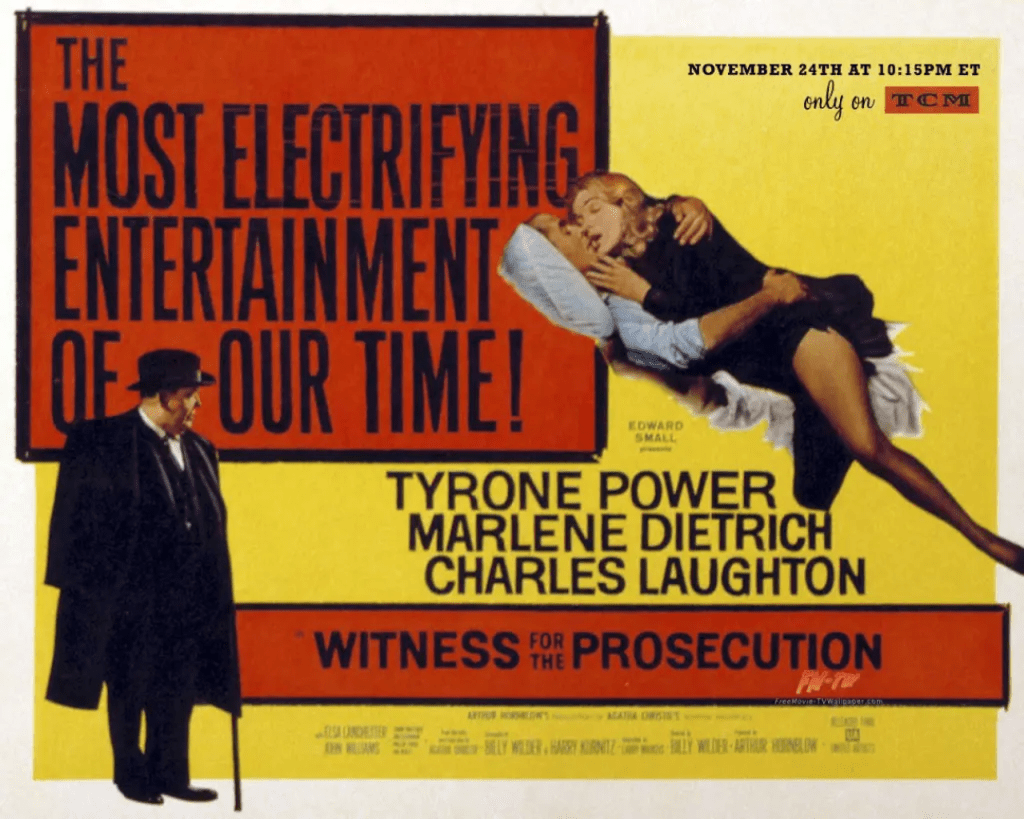

When we first see Charles Laughton’s Sir Wilfrid Robarts at the beginning of 1957’s Witness for the Prosecution, he’s bickering with Miss Plimsoll (Elsa Lanchester), his live-in nurse, about a variety of things but mainly his health. The aged defense attorney has just returned home from the hospital after a major heart attack and she’s recapitulating the stringent instructions from his doctor. We have every reason to believe that Wilfrid’s animosity is a consequence of his own character — a curmudgeonly, stubborn old man who just wants things done his own way, by the books, or at the very least by his own proclivity. However, we would be wrong to assume that this is all his character is.
Once Wilfrid leaves Miss Plimsoll, he adjourns with his office manager (Ian Wolfe), which paints a slightly different portrait of the lawyer. Suddenly, he’s got slightly more sadness in his eyes. He finds out that he’s been relegated to uninteresting cases like divorces and tax appeals instead of capital crimes like murders. Leading up to the acquiescence of his diminished role, Wilfried is frustrated, incredulous, and a bit pitiful. Then shortly after, two men knock at his door requesting he represent one of them in a murder case. After some resistance — since he had just finally accepted his newfound “diet of bland civil suits” — Wilfrid eventually agrees and seems to have found his energy once again. In the room with the two men, one of which is the defendant Leonard Vole, played by Tyrone Power, Wilfrid acts like one of the guys, joking, smoking cigars, and displaying that indelible twinkle that Laughton would always have in his eyes no matter which role he inhabited.
These three different dynamic shifts occur in the span of just 10 minutes. His annoyance with Miss Plimsoll earlier no longer feels like archetypal script writing; a grumpy old lawyer who just barks at everyone. Nor does it feel momentary or even impulsive due to Wilfrid’s current health condition. Rather, we could surmise — and this will be substantiated later on — that he and Miss Plimsoll have some sort of ongoing friction.
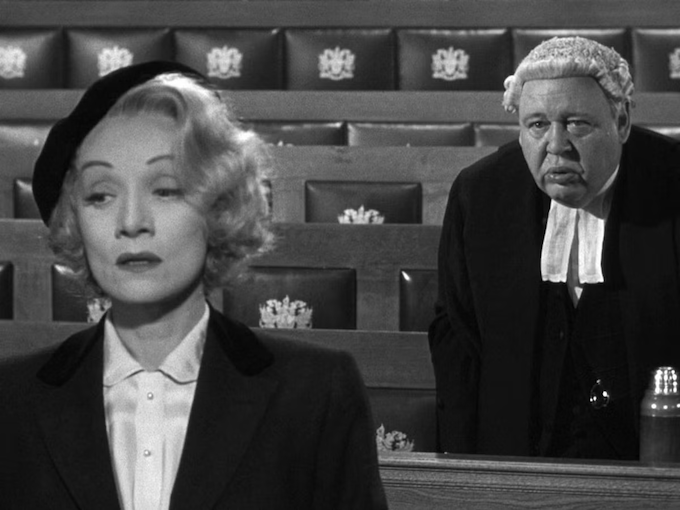
Although you might assume otherwise, Laughton never seems to portray the same type twice throughout his filmography. This is the type of nuance the actor brings to every one of his performances, either big or small, meaty or thin. We’ve seen, in the past, the actor bring new levels to shallow or cliched characters in a way that was never written into the script or intended to exist by the director. Be it subtle facial ticks or well-placed smirks, he always seems to believe that his characters are lived in before he even steps foot in them. And in a time when “leading man” meant attractive, skinny, and young, Charles Laughton carried a picture better than anyone.
After just 10 minutes, Wilfrid Robarts’ character range is well set for us, the audience, as he now gets to work figuring out if his potential client is, in fact, guilty of the crime he’s being charged with. Leonard Vole is a young inventor who befriends an old rich widow, Mrs. French (Norma Varden). We see through flashbacks how they met and how smitten she was with him, despite the fact that he was married to Marlene Dietrich’s Christine. Well one day, it’s discovered that Mrs. French is murdered and, due to the fact that he recently became the main beneficiary of her will, Leonard is now the primary suspect.
Although few surprises come up during the subsequent courtroom scenes since we’re told (almost) everything in the first act, they play out with energy and repartee that make them fun to watch. Laughton is brilliant in the way he goes from confident to defeated to ostensibly ambivalent without losing any of his charisma or incidental mystique.
Speaking of mystique, Laughton’s economically developed character may be the most ordinary thing about this movie. If you make it to the end of the second act, you’re in for a whirlwind of neck breaks that only feel more blindsiding because of how starkly ordinary the previous string of sequences had been — held together and made more effective by Laughton’s brilliance, Dietrich’s chilling sneer, and a likable defendant in Power.

Looking back, it’s easy to see how the film’s biggest twists were in fact telegraphed, especially when considering certain series of events. For instance, why would the answers for the entire case come out of the blue at the eleventh hour from some character we’d never met or heard of before? Agatha Christie (whose play this movie is based on) surely would have employed some sort of setup for that payoff. This is not Giallo; the Chekov’s Guns are not inconsequential to the rest of the story.
Billy Wilder directs the picture with a level of poise that works differently than the type that would have been present if it were helmed by Alfred Hitchcock or Sidney Lumet. Wilder gives his actors a little more autonomy while sprinkling in some physical comedy along the way. Laughton doesn’t get as much freedom as he does in, say, Island of Lost Souls — a B movie where the performances themselves are never the point, thus offering room to truly get wild. The script (by Wilder, Larry Marcus, and Harry Kurnitz) is much better here, and the words Laughton utters are always there for a reason.
If the showcase of Laughton’s acting and Wilder’s direction is in the first act, the parts you’ll remember most are undoubtedly in the denouement.
The story of Witness for the Prosecution is less about keeping the audience on their toes and more about letting us retain the illusion that we know the whole story; leading us to believe that this is an open-shut case requiring an uphill battle for Wilfrid and Leonard to earn their victory (which itself can be rather anticlimactic once this happens). On the contrary: We are in this with Wilfrid. He’s our surrogate. We’re in good hands.



 The Twizard
Leave a comment