


People’s love for 1933’s Baby Face may be tied to the celebration of women’s promiscuity — which itself is a strange, if not dangerous thing to champion — but the reality is that Alfred E. Green’s seminal pre-Code picture isn’t sure itself whether to applaud Barbara Stanwyck’s Lily Powers or to condemn her. It’s that very equivocality that makes it a challenging film despite its monomaniac premise.
While quite myopic as many early talkies could be, Baby Face is quite ballsy in its story about an uneducated woman who, thanks to the misguided advice of an old literary enthusiast, works her way up the ranks of a bank by sleeping with whoever’s in charge on her floor. Throughout her process, she becomes more and more apathetic toward men, viewing them only as a means for her own selfish gain. Stanwyck operates with such palpable anger at her core and a newfound confidence, both of which are, at the end of the day, still gifted to her by men.
To be fair, almost all of these men are doing the same with her, using her for sexual pleasure at the cost of their own loved ones at home. She has no respect for these guys, weak enough to fall victim to her tricks, and the men reciprocate the lack of respect since she’s made herself a literal object to them. Lily has desensitized herself so much so that she can’t even notice when a good one comes into the picture, who also happens to be the most powerful man at the bank, Courtland Trenholm (George Brent).

Courtland isn’t the typical antithesis of the male species as we’ve witnessed by this point in the movie. A lesser film would have had him challenge Lily at every turn, becoming the antidote to her subjugation by aggressively pushing back and humbling her. And you almost expect that to happen here. Instead, Courtland has a similar trajectory as the rest of Lily’s male victims, falling in love with her and letting her have whatever she wants. The difference, however, comes with his own purity. He doesn’t exploit her or manipulate her or keep their relationship in secrecy. We soon realize that the other men, who appoint her as their mistress and attempt to manipulate her, are in their own way pushing back. Instead, Courtland changes Lily through kindness and earnestness.
Lily’s evolution throughout the film isn’t overt, or can even be classified as gradual. Rather, it’s shown subtly through the conveyance in Stanwyck’s eyes as she descends more and more into loathing, even self-hate, the more she pursues her ambitions. Her resentment is so strong that even when she should be happy, with Courtland, she continues to feel empty. But rather than directing her scorn outward like she had been, it’s now directed inward, even though she’s reading it the same way as before. It’s not until the very end when she realizes that she’s become the monster.
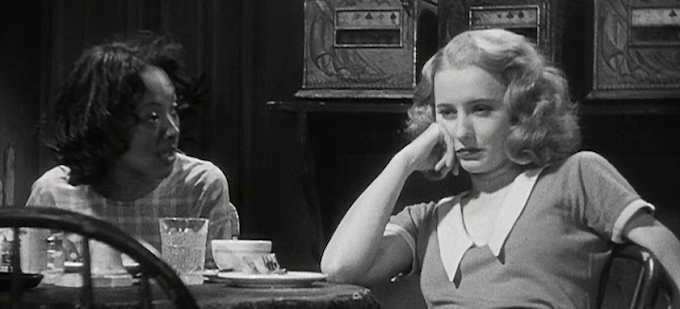
Arguably the first actress of the talkie era to really forecast what the future of performing would look and sound like on film, Stanwyck is brilliant here. She doesn’t deliver her dialogue with the same self-aggrandizement of other women who crossed over from the silents speaking every line as though it were her last. Stanwyck has gravitas, yet understands that some, if not many, words are less important than others. And she does all this as a character who carries the entire movie without needing to be liked by an audience.
Deceptively deep like the best classic films, Baby Face is a coming-of-age movie in its own right, highlighting the difference between like and respect, while showing that, ultimately, it’s giving and receiving respect that actually makes you the happiest. Finding it is the real hurdle.


 The Twizard
Leave a comment