


The 96th-annual Academy Awards just concluded tonight and Oppenheimer, expectedly, took home the award for Best Picture. It wasn’t a surprise to me or anyone else (probably). However, what should have been a surprise was how few nominations the film Past Lives received: just two (Best Picture and Best Original Screenplay). And while it may have been the most unambitious of the Best Picture nominees, it certainly stirred me (and I’m sure a lot of other people) much more than anything else I saw this year.
For those of us raised in one place, the thought of not only immigrating but assimilating into an entirely new culture is terrifying and unfathomable, especially as a youngster. Almost all of us born in the United States know at least a handful of people who are originally from a different country (in California I knew more than a few). And although we become part of their new lives here, we tend to forget about the lives that were left behind as a result. Even as the person experiencing the move, there’s a tendency to divorce yourself from your previous life in order to be more successful in your current situation. And for the people you did leave behind, you’re forever frozen as you were before you left.
There’s a reason why Celine Song’s debut film Past Lives takes place across 24 years, with two of its leads experiencing their connection with one another at three equidistant points in their lives: at 12, 24, and 36 years old. We see how our relationship with our past can evolve, change, or boomerang, but will never quite disappear entirely.

Nora left South Korea when she was a child, but not before establishing a sort of puppy love relationship with another boy, Hae Sung. When she was in her 20s, Nora (Greta Lee), now working in New York as a playwright, discovered that her former crush (Teo Yoo) was looking for her. They reconnect, but only via Skype, since Hae Sung is still in Seoul. It’s clear that he is falling in love with Nora now as a young adult. But while Nora’s reciprocated feelings are newfound, Hae Sung’s feelings seem to be a refracted version of the infatuation he experienced for her as a child, suggesting a more idealistic sense of the notion of love.
The more they talk, it becomes clear that Nora leaving him all those years ago left him in a chronic state of sadness from which he never quite fully recovered. Meanwhile, Nora is somewhat aware of her nostalgia, viewing Hae Sung as a representative of her childhood rather than the other way around. Since neither can abandon their current commitments to visit the other, Nora suggests they stop talking so they can move on with their lives.

Of course, during their time apart, both of our characters find love with someone else. Nora, being more willing to move on, gets married to Arthur (John Magaro), an American novelist. They seem blissfully happy with one another, even over a decade later, and possess an honesty and candor that most marriages can only aspire to have. Even when Hae Sung does finally show up, there are no secrets despite the small waves — nay, wakes — that are made. Hae Sung, on the other hand, never fully commits to his own girlfriend back home and ends up parting ways. This is when he finally decides to come to New York to see Nora. However, it’s long been too late.
Combating our weakness for nostalgia with our aversion to reality, Past Lives challenges its audience by counterpointing Hae Sung with a shorter, subjectively less attractive man who offers authenticity but perhaps no real seduction. Hae Sung is mysterious and brooding, while Arthur is transparent and realistic. Do we root in favor of Hae Sung or against Nora? Arthur so incisively points out, “In the story, I would be the evil White American husband standing in the way of destiny.” Can we root for something because it’s pure and happy, or are we drawn more to romanticism, even if it means the crumbling of ethics and disruption of happiness?
Luckily, this dilemma is addressed right at the point in the film when Arthur becomes humanized. In turn, writer-director Song provides us with catharsis for anyone who ever thinks he’s inadequate — the result of being told we shouldn’t be the hero of our own story. Hae Sung has a definite protagonist complex, going against logic and sanity because he thinks he’s entitled to some sort of victory. He may get a level of closure but not much more: “I liked you for who you are. And who you are is a person who leaves. But for [Arthur], you’re the person who stays.” He’s also fallen in love with this romanticized version of Nora, not Nora herself.

The particular brand of love story presented here starts early on, before the people involved could even make decisions about where they’re going in life. Like some of the most entrapping love songs, Past Lives is equal parts mournful and fantastical, yet retains that dreamlike state that makes us want to hang on to feelings we know we’ll never actually be able to satisfy. Song’s script is so eloquent and emotionally evocative that even during the slower moments, we remain engaged with our own thoughts. We become fixated on our two leads, beginning to speculate what we would do in this situation and how it would feel.
Magaro’s performance shouldn’t go overlooked as he immerses us into a situation that we already feel entangled with long before he shows up. Lee and Yoo are both very good but Arthur’s character, by nature, brings balance to the story in a way we didn’t know we needed — and in a way that makes us okay with what happens next. Song writes some of the most authentic dialogue I’ve heard in a while. In a single scene, the entirety of the film’s themes are expounded upon at once and it doesn’t feel on-the-nose or lowbrow.

It’s tempting, if not dangerous to romanticize our own past. But it’s crucial to discover if we’re actually in love with figures of yesterday or simply what they represent for us. Nostalgia doesn’t happen because of the state of our current life. Despite popular belief, the phenomenon occurs for those whether they love or loathe their current condition, and ditto for their past. Rather than a longing for a time perceived as better, nostalgia is a plaintiveness for a distilled version of our past; a hunger to retain our perception of the world when we were more innocent and blissful instead of the actual state of that world back then.
For a film about fate, Past Lives makes sure that there isn’t much coincidence involved with its plot, unlike a typical plot, where the very idea of coincidence feels a bit abused and exploited — where fate feels more like coincidence than it does provenance. On the contrary, Song’s story feels like it could actually happen, thus increasing the catharsis and relatability of its events.
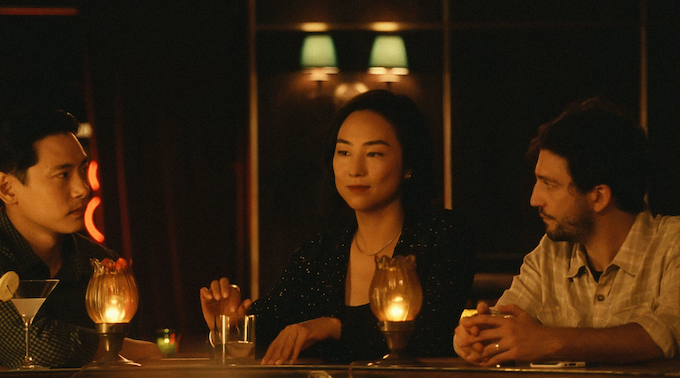
Past Lives brings a lyricism to nostalgia and fate in a way I don’t think I’ve ever seen in cinema; in a way that a conventional storyline couldn’t tackle properly. Feeling less like story beats than it does a breathing organism just as complex as its characters, Song’s picture may provide you with one heck of a dilemma while still reminding you that some decisions really aren’t as complicated as the movies make them seem from afar.


 The Twizard
Leave a comment