
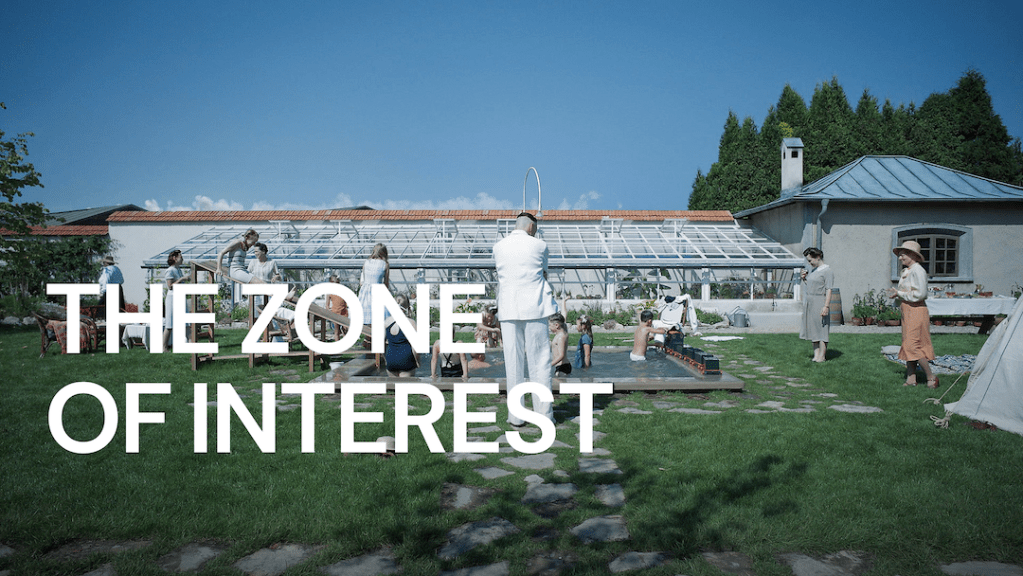
It’s a trend in contemporary cinema to reveal to the audience the perspective of the villain in order to garner sympathy for them. But what if those villains were real people and their atrocious sins were still felt by us in today’s world? That’s the unique take that drives Jonathan Glazer’s The Zone of Interest, which doesn’t only use a family of Nazis as its protagonists but shows us their evils through implication and frank discussion.
The people at the center are the members of the Höss family, whose patriarch Rudolf (Christian Friedel) was the Commandant of Auschwitz, meaning he ran the concentration camp as a Nazi during World War II. His ideas regarding how to “more efficiently” murder Jews cost the lives of hundreds of thousands of people at that time. His family, however, lived an idyllic life in a beautiful estate right outside of the camp’s walls. There was barbed wire separating their backyard from any unwanted infiltration.
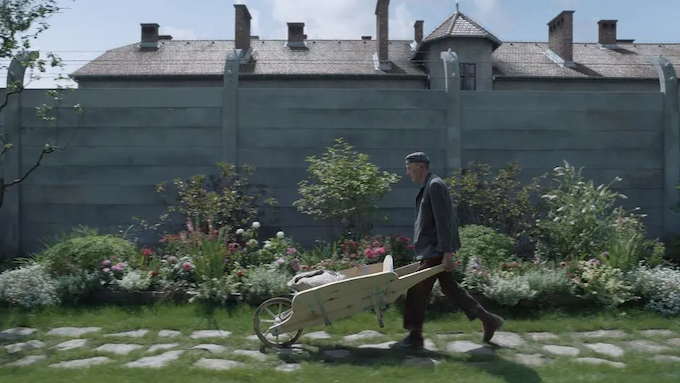
Where most films would exploit a situation like this to satirize its subjects, this Best Picture nominee brings realism to the table because it knows that we don’t need to be convinced of anything. We’re not asked to indict these people because we’d already made that judgment decades ago. And in order for satire to be effective, we have to have some level of empathy. Rather, the movie challenges us by showing us moments that would traditionally be used to connect us with the characters as a way to test our own coldness. Can we laugh with people who we know are evil? When Rudolf has a salacious affair with his mistress, are we concerned for his wife’s feelings?
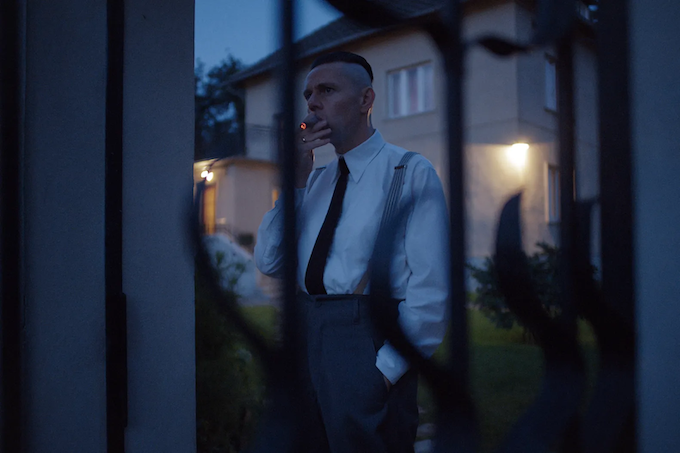
Not a single Jew is visually depicted on screen. However, we are well aware of their presence through screams in the distance. It reminded me of the barn sequence in Come and See, which manages to be the most gruesome moment in the 1985 film even despite all the horrific violence we can actually see elsewhere in the plot.
At once immersive in this situation because of the sheer fact that we have no one else to follow, The Zone of Interest also knows how to keep us at a distance. Most of the scenes are framed in wide shots, retaining the coldness that we already feel for these people. I’m still unsure if the uneasiness would have been more effective in a more conventionally-shot film (i.e., with more close-ups and intimate moments), but keeping us at a distance furthers the director’s test of the audience. How frustrated will we get that we can’t get closer to these subjects, thus more immersed in their lives? Oftentimes we obsess over serial killers and Nazis because we fall seduced to their dark deeds. Will something as vérité as this still attract us to evil just as we’re intrigued by the Vikings or the pirates?
Simultaneously about the ease at which we will sell our soul in order to achieve an idyllic lifestyle, white picket fence and all, The Zone of Interest never dissects the hate of its villain protagonists but merely reminds of of their self-absorbed motives.
In his review, David Ehrlich posed that there is no right way to depict an atrocity. However, I would counter that the appropriate way is to show it without the crutch of subjectivity. Aside from Come and See, this may be the most brutally effective piece of anti-Naziism I’ve seen fictionalized. A movie that exclusively features villains in a medium whose success typically relies on empathy from the audience, The Zone of Interest is one of the only films I’ve ever seen that’s removed empathy from the equation. Conversely, take something like A Clockwork Orange, which exploits our empathy to make us root for a character who’s proven to be the personification of hedonistic evils. Glazer’s picture, with its equally-as-strange perspective, exists simply to bother us, as it should.



 The Twizard
Leave a comment