

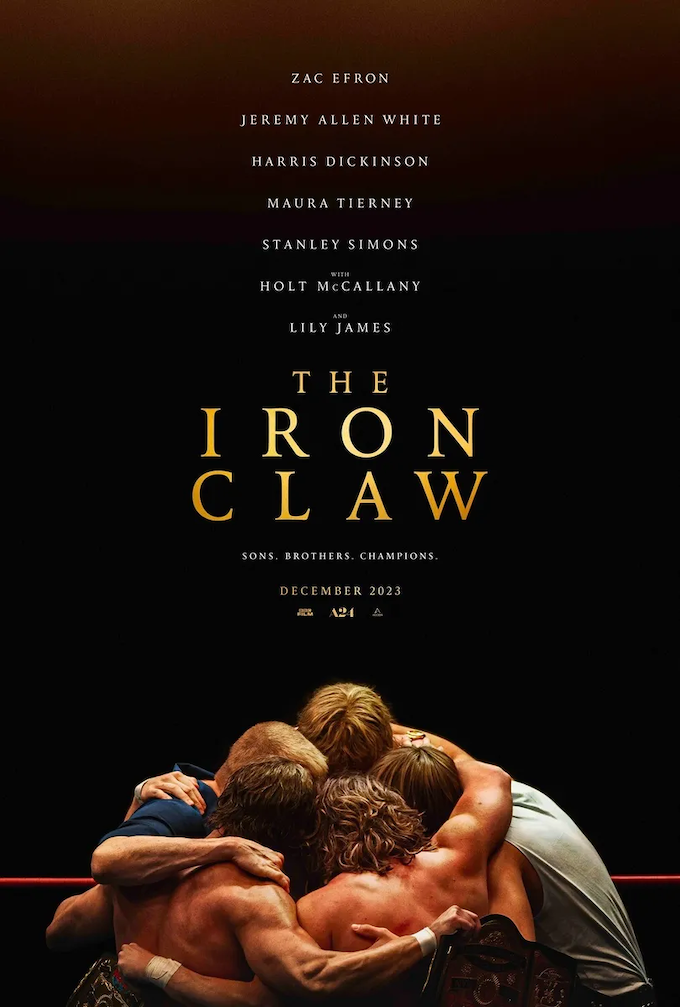
If the phrase, “You can’t make this stuff up,” could be applied to any real-life story, the Von Erich family might earn first dibs. In nine years between the ‘80s and ‘90s, the Texas-based wrestlers lost four sons — three to suicide — on top of one they had already lost as a young boy years earlier. However, what makes their saga interesting isn’t just the “what” but the “why.”
The implausibility of these true events — known by the family as “the curse” — not only sets up the story of The Iron Claw but almost prevents us from believing that it actually happened. To mitigate the audience’s skepticism, writer-director Sean Durkin even left out one of the Von Erich brothers, and his suicide, entirely.
Needless to say, The Iron Claw is a depressing viewing experience. Luckily, we have a grounding force in our protagonist Kevin (Zac Efron), the second-oldest son who behaves like the oldest ever since the death of his older brother when he was six. He looks out for his younger brothers, played by Jeremy Allen White, Harris Dickinson, and Stanley Simons, all of whom are at the mercy of their hyper-competitive father, Fritz (Holt McCallany), who was once a moderately successful wrestler and now trains his sons to follow in his footsteps and achieve what he never could. What could go wrong?

Using the contrivances of professional wrestling as an analogy for control, the film heavily deals with the irrational pressure of not giving up in life. However, the characters never realize that if a goal is not organically inspired, sometimes giving up is the smart thing to do — as long as you’re not hurting yourself or someone else in the process. Fritz chastises any form of “giving up,” even if one of his sons broke his back, was depressed from losing a limb, or wound up with permanent brain damage. Tears and self-pity were frowned upon. Yet it’s not the tenet itself that’s problematic but the motivation behind this idealistic perseverance: pride and power. And with no outlet for surrender, two of the brothers resorted to the ultimate white flag — a form of giving up that you cannot come back from.
As far as toxic movie parents go, Fritz isn’t atrocious. We see how a combination of circumstance, nurture, and just plain bad luck plays into the unfortunate fate of him and his family. Durkin makes sure we know that while their tragedies can all be traced back to Fritz, they’re not all necessarily because of Fritz.
With his brothers all struggling to find success outside of their father’s parameters, Kevin’s evolving worldview actually allows him to outgrow these pressures. Fortunately, he has help from a good wife, Pam (Lily James), who provides the proper support when needed and is also a beacon of hope, which is something the other brothers lack.
In response to the ostensible Von Erick family curse, Lily James’ character says, “I don’t believe in curses; I believe we make our own luck.” Yet her interpretation of this truism didn’t suggest over-planning or manipulating the lives of others to fit in with her own plans. On the contrary, Pam and Kevin simply live the right way, or at least as close as possible. When bad things happen, they take the blow and push forward, waiting for their turn to come…or not. They find that pivoting is a solid middle ground between quitting and stubborn resilience.
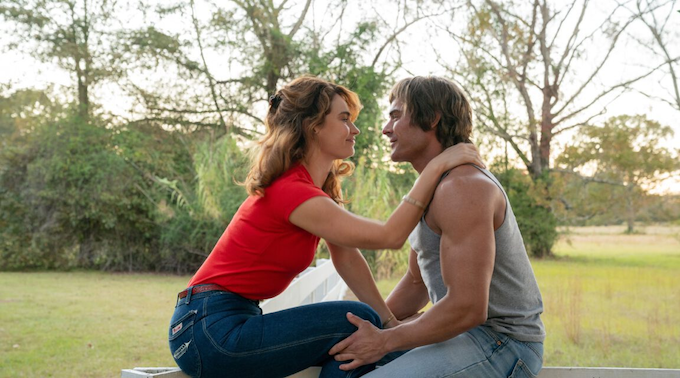
Kevin himself is pretty unique. While he prides himself as a wrestler — and is undoubtedly the most passionate of the bunch — he treats wrestling as an actual sport, maintaining the maturity of any successful athlete and sticking to a strict workout regimen. When Pam initially hits on him, he’s unaware of how to ask her out in response, despite being one of the most famous wrestlers in the state.
Later on for his title match, he faces off against Ric Flair, the most flamboyant wrestler at the time. For the audience, the juxtaposition is noted. Kevin doesn’t wear flashy clothes, he never parties or does drugs, he can’t speak on the mic, and he has no real showmanship whatsoever. He’s like a quiet boxer trapped in the wrong sport.
Spending years researching the Von Erichs and being a personal fan of professional wrestling, Durkin imbues his film with passion and enthusiasm, and it shows. Inspired by fighting movies that came before it, The Iron Claw carefully reworks classic biopic archetypes and plot beats, though seems to use them to show the audience just how much he’s improved upon them here. Durkin’s filmmaking elements aren’t as overt as they would be in other high-art cinema but they’re still of a higher quality nonetheless.
Consider the meticulous focus work and framing, or even the careful avoidance of wrestling as a staged sport. I also love the way he maintains a more “jukebox-heavy” soundtrack, which I’d usually condemn. But here, instead of splicing up songs, he plays them from beginning to end most of the time. And a lot of them are in diegesis.
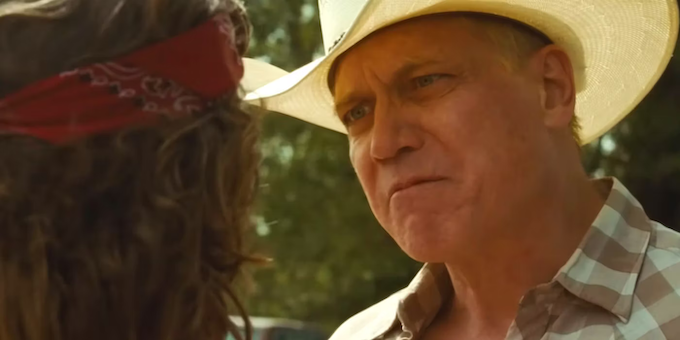
Durkin’s script is equally as impressive, with clever utilization of Fritz as the antagonist — though none of the characters are written to be black-and-white. We’re left pondering the complex motives and behaviors of both parents. The mother, played by Maura Tierney, is aloof and seemingly rude, even to her sons. However, her motivations become elucidated later on. Outnumbered as the sole female in her house, she quietly allows her husband to have the entire say in the matters of wrestling. But when it has to do with other issues, she’s not afraid to put her foot down. She exhibits the kind of fortitude and faith that her husband only boasts about. And later, with all of the sons gone, she’s able to reclaim her own passions.
Narratively, the structure is also interesting. The first half of the movie appears like a standard biopic but we don’t realize it’s setting up all this happiness just for loss later on. Unusual for true stories, which often struggle to stuff every event into a limited runtime, certain scenes exist only to enhance camaraderie and show the dynamic between the brothers.
There’s a beautiful parallel between the beginning and end of The Iron Claw which might be somewhat on-the-nose but feels welcomed for a character who endured so much hardship. Durkin shows us the same image of Kevin, now as an adult, with his pregnant wife and two kids — just like him and his family years before when we first meet them. Despite our tendency to think that all this tragedy was for nothing, we can see how Kevin Von Erich weathered the storm, finally got his reward, and saw that it was much better than he ever could have imagined.


 The Twizard
Leave a comment