
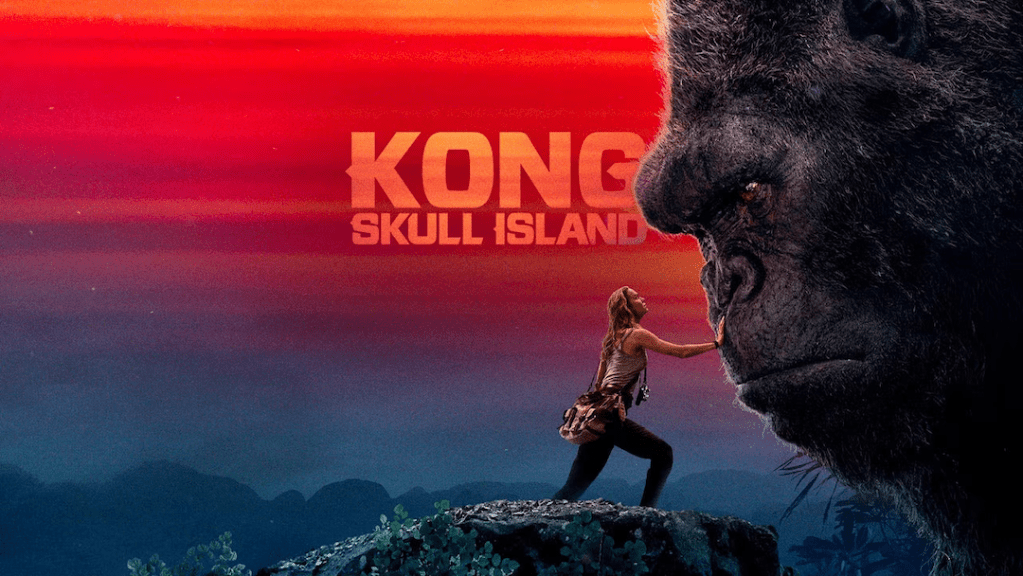
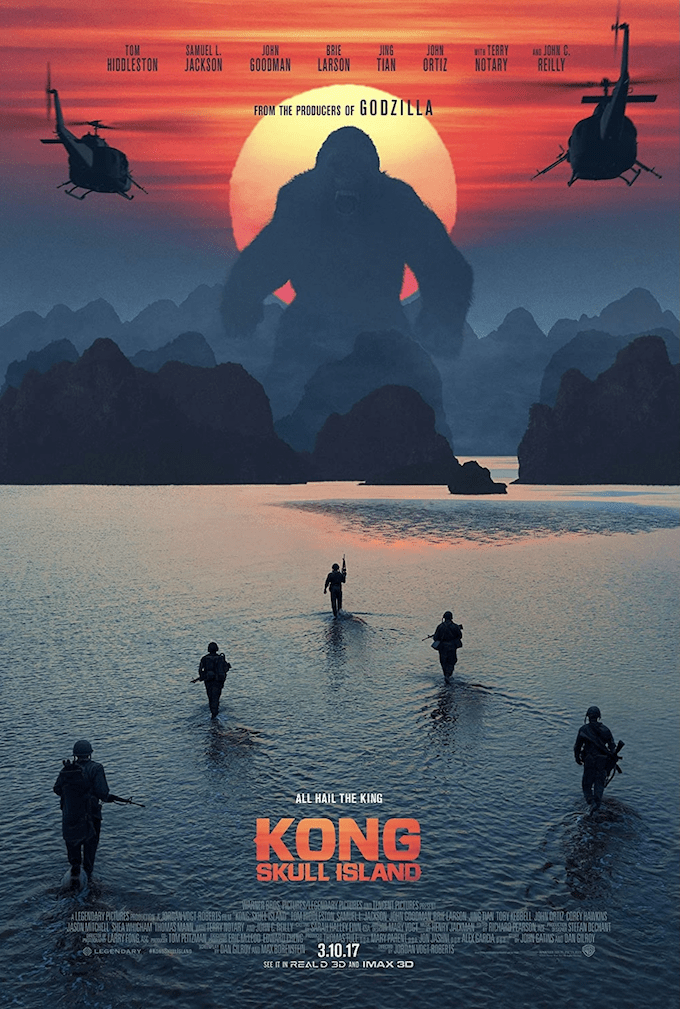
In 1933, RKO’s pre-Code masterpiece King Kong changed moviemaking forever. With groundbreaking effects and set design, and inventive horror tropes, many of which are still used today, the film has become one of the most influential of all time. Whereas most other monster movies of that era adapted literary classics, such as Dracula or Frankenstein, King Kong was totally original.
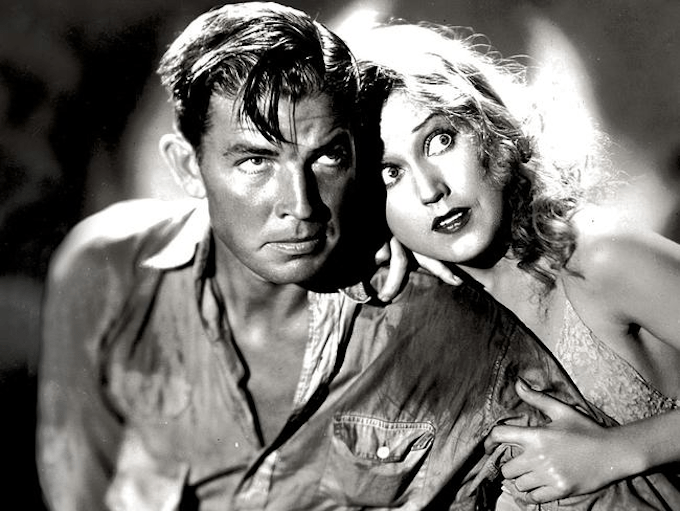
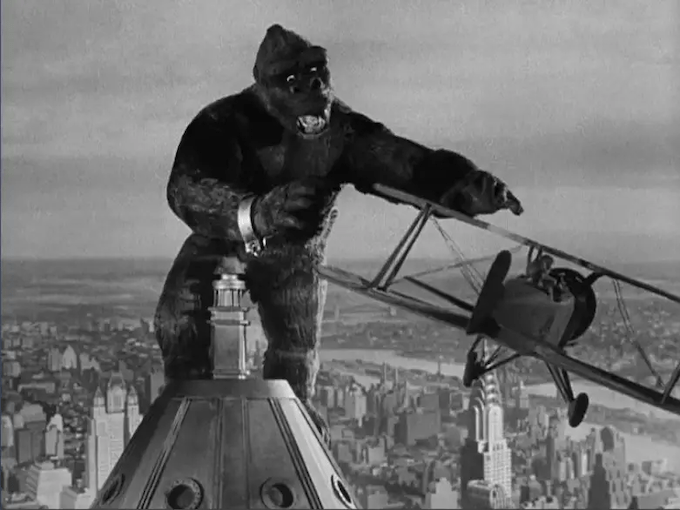
It stars Robert Armstrong as Carl Denham, an eccentric filmmaker who attempts to make a movie on an uncharted island upon hearing rumors of a giant ape who lives there, along with other various prehistoric creatures. He asks a naive young woman, Ann Darrow (Fay Wray), to star in the picture, much to her excitement. However, upon arriving on the island and entering the ape’s habitat, the titular Kong seems to take a liking to Ann, kidnapping her and taking her back to his lair, where she now must be rescued by her love interest, played by Bruce Cabot.
Eventually, Denham captures the ape and brings him back to New York, selling tickets to see him shackled in chains in a Broadway theater. Rather than respecting nature and leaving it be, Man has now tried to exploit it for money so others can gawk at it, only escalating matters into an all-out war with Kong. Outsiders who don’t know the context just see a scary ape destroying their city. The subtext is never explicitly stated, nor should it be. This sort of presentation of themes was more common back then. We were tasked with reading between the lines ourselves.
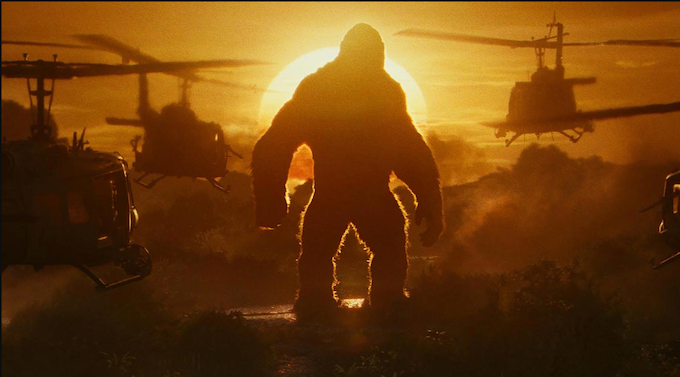
Starting with the basic framework from the 1933 film and tweaking it here and there to justify the new adaptation, 2017’s Kong: Skull Island, if nothing else, follows suit in that regard. Instead of taking place in present-day 1933, the story is set in 1973 amidst the Vietnam War. Rather than a fanciful filmmaker following a rumor of an ape on an island in the South Pacific, it’s a government employee with a well-researched theory, trying to convince senators to provide a team to accompany him to the island without getting laughed out of the room. This version of Skull Island still has the primitive natives, the log-wall fortress, the daring hero, and the blonde leading lady for the ape to fall in love with. And while it may not break nearly the kind of ground as the pre-Code original, it gives us a lot of the elements we want in a movie and executes them masterfully.
84 years later, the themes had already been explored and written to death, and thus the task for screenwriters Dan Gilroy, Max Borenstein, and Derek Connolly was to figure out an entirely new way to tell a similar story
Despite the 1933 film inspiring an entire kaiju sub-genre — including the likes of Godzilla, Gamera, and the more modern Super Sentai (along with its American iteration Power Rangers) — there were only five American live-action adaptations for the character prior to the release of Kong: Skull Island in 2017 — most notably Paramount’s 1976 remake and Peter Jackson’s 2005 epic — even though the Eighth Wonder of the World had been in the public domain for years (a whole other saga in itself). So Warner Bros. and Legendary Pictures decided to produce the boldest and deepest King Kong film yet as the second installment of their recently launched MonsterVerse.
84 years later, the themes had already been explored and written to death. And thus, the task for screenwriters Dan Gilroy, Max Borenstein, and Derek Connolly was to figure out an entirely new way to tell a similar story; not to repackage the same message, but to give it new context. And with that new context, a whole new batch of themes are able to emerge organically.
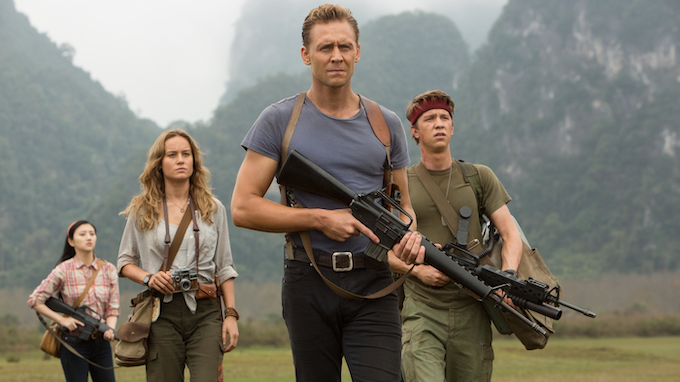
John Goodman plays Bill Randa, the head of a secret US government organization called Monarch, whose main focus is on researching Earth’s most hidden creatures. He eventually gets the funding he needs and recruits an Army unit, led by Lieutenant Colonel Packard (Samuel L. Jackson), which accompanies him to Skull Island under the pretense of seismic research. In reality, Randa is investigating the Hollow Earth Theory, a folkloric idea about sections of the Earth that contain hidden underground tunnels where mythological creatures reside.
Randa also recruits famed British tracker James Conrad (Tom Hiddleston) and anti-war photographer Mason Weaver (Brie Larson) to help them on their journey and document their travels. When their team of helicopters arrives on Skull Island, they begin dropping bombs on the previously untouched lush landscape, disrupting and destroying much of the wildlife there. The troops are then greeted by a 104-foot-tall gorilla who begins effortlessly slapping helicopters down and killing those inside. They fire their weapons at him, but he remains standing until all of the helicopters are down. With some dozen survivors split up into two groups in separate parts of the island, they now have only a few days to find each other and make it back to the rendezvous point by the designated time.
Although the blame for this conflict is pretty obvious, director Jordan Vogt-Roberts does something else very similar to directors Merian C. Cooper and Ernest B. Schoedsack of the 1933 original in that he doesn’t lean into any judgment of what his characters are doing. We see these troops dropping bombs, and yet we’re not told who to root for — that’s left for us to decide ourselves. For the first hour, there’s no clear antagonist. After all, in war, it’s not always that black or white. Characters have growth, regressions, and sometimes redeem themselves. And other times, they never get the chance to.
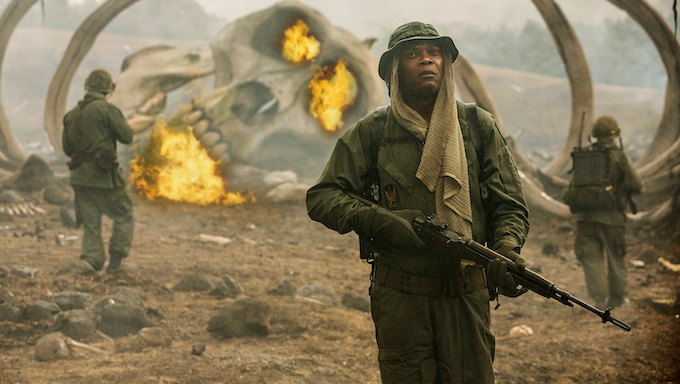
The true villain evolves over the course of the film as we see two contrasting perspectives slowly develop away from each other: one group of people that sees Kong as a creature to be killed, and one that sees him as a creature to be protected. Even though every person starts out on the same relative side (i.e., monster = threat), it’s their perspective and experience that informs their beliefs, depending on which group of survivors they wind up with — also much like war. But no matter what, there are no archetypal sketches.
For a big-budget blockbuster, Kong: Skull Island is more astute than most, with a very obvious but unique and powerful theme at its center. The movie opens in 1944 during World War II when both an American fighter pilot and a Japanese fighter pilot land on Skull Island. At first, these men engage in close combat trying to kill one another. But eventually, we find out that the two former enemies at war become brothers — a la Hell in the Pacific — as they both end up stranded on the island together for years with giant creatures trying to eat them alive. Suddenly the war doesn’t seem all that important to them anymore.
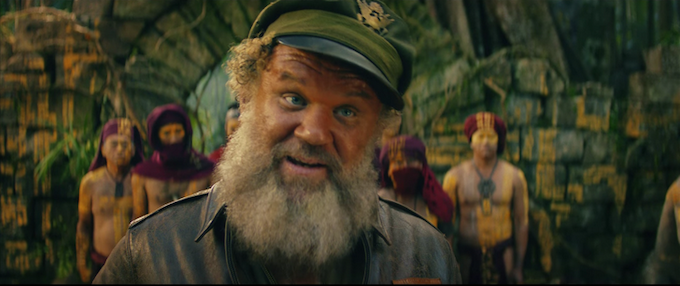
Half of our 1973 team finally meets up with one of these World War II veterans: Hank Marlowe (John C. Reilly), who’s been stuck on Skull Island for nearly 30 years and has found refuge amidst its indigenous peoples. Being essentially alone for years following the death of his Japanese comrade, Marlowe explains that he can no longer tell whether he’s speaking or thinking. Reilly is the movie’s comedy relief. And even though he rocks the tone a bit, his moments are always entertaining.
Marlowe informs Conrad and Weaver that, in fact, Kong is the protector of the innocent on this island, and that the real evil lies underground in the form of vicious creatures known as skullcrawlers. Since Packard and his team on the other side of the island don’t see things from this vantage point, they’re still on a hunt to kill Kong for murdering their men — never once considering that it was they who started the fight in the first place by bombing the ape’s home. As one soldier puts it, “Sometimes an enemy doesn’t exist until you go looking for one.”
Vogt-Roberts still manages to show the unfortunate brutality of war that defies all poeticism. We learn early on that no character is safe just because they’ve been developed or because we like them.
Kong: Skull Island is a definite parallel of war, with the conflict in Vietnam serving as a subtext. These men enlist either voluntarily with the hope of finding purpose, or involuntarily, fighting a battle (and often getting killed) without ever knowing what they’re fighting for — much like the characters in this film who were lied to about their mission. Vogt-Roberts still manages to show the unfortunate brutality of war that defies all poeticism. We learn early on that no character is safe just because they’ve been developed in this story or because we like them.
Perceptive religious allegory also permeates the film as Samuel L. Jackson’s character shows misdirected anger towards his protector — the God-figure in this story — and tries to eliminate him. But when you suppress the good, the evil comes out to play and it’s very hard to get rid of it. “It’s time to show Kong that man is king,” says Packard. Yet it wasn’t even the bombs that created a Hell for these people, but how they conducted themselves afterwards. Did they ever realize that they were at fault, or were they simply redirecting blame to Kong for all of their misfortunes? Their bad luck has nothing to do with the hand they were dealt, but how they’ve chosen to play that hand.
On a technical level, Vogt-Roberts imbues a beautiful energy behind the camera with thoughtful composition, picturesque framing, and a plethora of effective rack focuses. There are no wasted shots as the director successfully executes a fully thrilling and emotionally engaging cinematic experience. Simply put, this is a quintessential example of why we go to the movies.
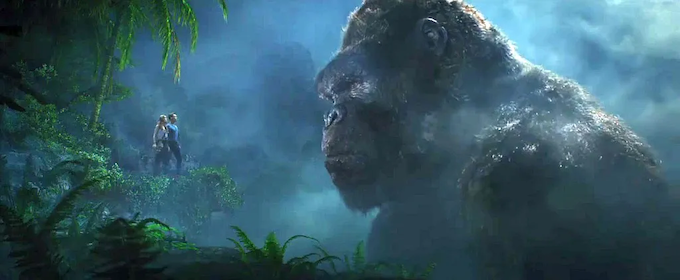
We have a cast full of A-listers but, in a way that feels very ‘70s, we’re not sold on the film because of its marquee names. Heck, we’re not even sure who the protagonist is right off the bat. As Jackson’s Packard becomes our villain — origins story-esque — Larson and Hiddleston become our human heroes. While Hiddleston grounds the film as a serviceable Bruce Cabot-type who combines swashbuckler bravado with stoic strength, Larson carries the picture in a big way as the emotional center and performs as if nobody told her that this was merely a summer blockbuster. Amidst all the destruction and the CGI, the actress actually conveys real looks of terror on her face; she’s really acting. For her, this is not just an action film, but a work of art. She’s the Fay Wray this time around and a true presence in this film.
There’s a tendency when remaking a movie, or retelling a story, to lean into ideas laid out by those before you. However, you could say that without the 1933 original, the filmmakers behind this 2017 entry may not have been as inspired to create something so complex and intricate. Not only are they challenged to reimagine these themes but to present them in a way that feels uncharted. They aren’t merely reinstating old commentary but interweaving it with characters who are just as complex.
In 1933, King Kong proved that a scary monster could have a wonderful spirit and the ability to impact those around him for the better — that is, if they cared enough to look. Kong: Skull Island possesses the same kind of intention, with the film itself being a window into ideas that are seldom presented in the cinematic medium, let alone this effectively; let alone in a big-budget, mainstream tentpole. A film so pure in vision, it’s one of the few that manages to entertain and fulfill us on an aesthetic and emotional level, while also challenging us mentally and philosophically upon digging deeper. Kong: Skull Island is exactly what you would want any movie to be. And with it, Vogt-Roberts has successfully created his own modern masterpiece.


 The Twizard
Leave a comment