
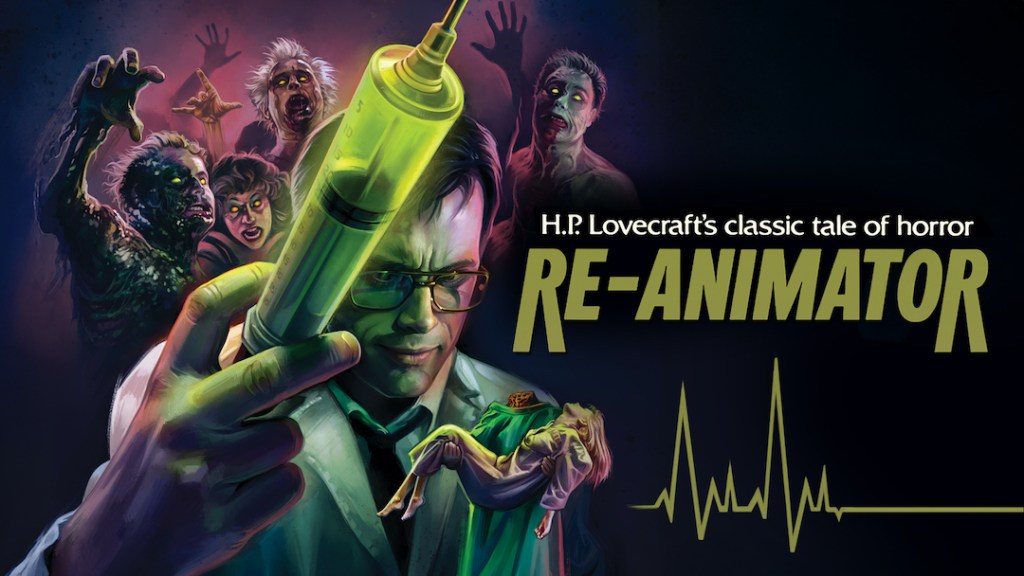

At a time when everything seemed to be slashers, along came an ‘80s horror movie that didn’t just use classic literature as its inspiration but pushed an arguably stale genre further than most had before it. Adapted from H.P. Lovecraft’s “Herbert West: Reanimator,” 1985’s Re-Animator felt fresh, weird, and a little bit dangerous. Its tone wasn’t serious, nor was it comedic — a glorified B-movie for the modern age. And like most B-movies, its legacy would go on to last much longer than its own era.
For its 40th anniversary, Ignite Films has released Re-Animator on Blu-Ray and (for the first time) 4K. Assembling plenty of special features from past releases, the distribution house has also produced some brand new content — all of which I reviewed below.
The Movie

With narrative momentum that builds so inconspicuously until it cannot possibly get any bigger and crazier, Stuart Gordon’s 1985 Re-Animator is one you won’t soon forget. Refusing to take an MPAA rating, the horror raised expectations for the efficiency of gore and heightened standards of how crazy a finale could be, inspiring the likes of Society, Street Trash, Dead Alive, and even Best Picture nominee The Substance.
Like the best of ‘80s horror cinema, the gore-fest in Re-Animator only heightens the visceral response by the audience but never creates a dependency by the material. Re-Animator holds up on its own because of its smart script (by Dennis Paoli, William J. Norris, and Gordon), unusual tone, and troupe of theater actors that know how to convey emotion and motive regardless of a camera in their face. But it all starts with the story, loosely based on an H.P. Lovecraft serial.

Medical student Herbert West (Jeffrey Combs) has figured out a way to make humans come back to life after they’ve deceased with a special serum. Just recently coming back to the US from Germany after his experiments raised suspicions, he moves in with fellow medical student, Dan Cain (Bruce Abbott), transforming his basement into a secret laboratory. Dan is initially skeptical of West’s eccentrics, but soon gets on board after he sees the potential of his new advancements. Itching to try out the magical reagent on actual human subjects, the pair sneaks into the hospital morgue with mixed results.
Dan is torn between this amazing discovery and his girlfriend Megan (Barbara Crampton), who’s wary of West. While Megan’s motives against West are murky, Dan’s position as a man of science precludes his own need for them, for better or worse. Standing in for humanity and its long-futile attempts at conquering death, he and West have nothing urging them to continue perfecting the serum, other than scientific duty and genuine curiosity. The lack of motive lessens the stakes for the characters but also raises an array of moral dilemmas. Does man have a responsibility to make scientific progress if it can lead to disaster? It’s the old “ends justifying the means” debate.
Gordon performs a balancing act with his three leads, understanding their dynamic perfectly. The triptych allows for an interesting predicament for a death-filled movie like this, in that we’re never sure who’s untouchable or not. Who’s going to be the one to make it to the end? This perfect prioritization of characters keeps us guessing. Then you throw in the reanimation of corpses, and anything’s possible.

You never feel like Dan and West are actual friends, but more partners after the same goal. After Dan gets on board with West’s experiments, he finds himself culpable for whatever transpires afterwards. But this movie is not as much about legal repercussions as it is finding the logical conclusion for the plot. Even before things get crazy, our intrigue in the story comes from the dual villainy of West and college professor Dr. Carl Hill (David Gale). An antagonist in the traditional sense, West pops up on our radar first. He’s secretive, dishonest, and generally unlikable. However, the more we understand that he’s actually just an Oppenheimer yearning to solve a riddle, the more we realize he’s far from the true villain of the film. Without any real motive other than self-preservation and self-aggrandizement, Dr. Hill emerges as a despicable human. And if the confines of being alive made him more careful with his actions, death eliminates any real reason to hide his nefariousness.
West is the type of character that never typically gets explored over the course of a film — whose arrogance serves as an obstacle to the protagonists. These are characters we love to hate, not someone we’d ever imagine we’d want to win in the end. Nevertheless, West never remains an archetype but gets developed in surprising ways; you can actually diagnose his psyche and motives in ways you won’t usually be able to do with these types of antagonists. Dan is the grounding force but West, in all his myopic insanity, is the constant. He not only becomes essential in catalyzing the plot but also in helping save the others from the mess he made — a true Dr. Frankenstein.
Like Gothic-sourced cinema, Re-Animator congeals is story with sets, not nature. There are effectively no outdoor scenes in this movie (much like a stage play), increasing its claustrophobia and strangeness. Outside, we would feel safe; things would make sense. Inside, we find ourselves constantly trying to make sense of the environment and finding an escape route. Most of the bad stuff in this movie happens in basements, where the sole exit is a flight of stairs or an elevator.
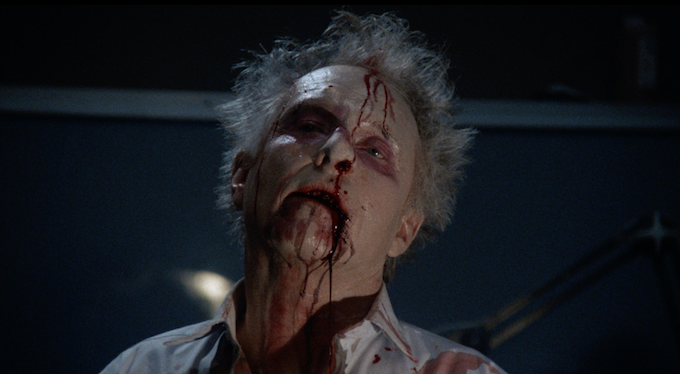
For this 40th anniversary viewing, I opted for the Integral Edition, which finds the happy medium between the theatrical version and the Unrated Cut. It’s about 20 minutes longer, and I honestly found the extra footage welcomed, giving the story room to breathe, building tension more, and developing characters like Dr. Hill, who previously felt undercooked.
The Integral Edition also ramps up the gore. And luckily, this is the type of film that just wouldn’t look as impressive without practical effects. Just like the theater world he came from, Gordon’s process was there on the screen. He had help from makeup wizard John Naulin, who manages to find the convergence point between schlock and realistic. The innards of each corpse feels like a slightly exaggerated version of what this would actually look like, but also feel plausible (and probably are).
Known for its intentional play on Bernard Herrmann’s Psycho underpinnings is Richard Band’s unconventional, nearly avant-garde, musical score, taking free form jazz ideas and blending it with a familiar meter, to create something no less than genius in its own right, while deftly increasing the anxiety of the audience.

My biggest issue with Re-Animator is its lack of heart, focusing on the brain instead. The inadvertent tongue-in-cheek tone brings an irreverence that’s always kept me at a distance. The comedy feels like an afterthought, as attested to by Band, who had to beg Gordon to let him give more comedic beats to the score.
Aside from the end, there are spots where Gordon could’ve definitely leaned into pathos more, such as the tragedy of Megan’s father or the crumbling of Dan and Megan’s relationship. There’s sadness to death, even if it comes with reanimation afterwards — and themes like this often get overlooked in favor of plot.
A glorified low-budget B-picture, Re-Animator is a combination of brilliance and oversights. There are some details that go sorely unanswered (e.g. What exactly happened to Dr. Gruber at the beginning?), subtext that doesn’t get explored (Why does Hill seem so wary of West before they’ve had any interactions whatsoever?; Why, exactly, can’t they go about these experiments in a more official way?), and sentiments can appear to be too hasty (Meg: “I wanted to hate you, I really did.”), but there’s a verisimilitude to the film’s dementedness that makes the audience up for anything. A snappy pace is the tradeoff, along with easily one of the most utterly bonkers finales in horror history.
Twizard Rating: 92
The Blu-Ray

Editions
The two-disc set features the Unrated Version (86min) and the Integral Version (105min). Unlike most “unrated” editions, this one sort of predates the R-rated cut that was resubmitted for MPAA approval. It’s also the edition that made it onto home video releases, thus finding the movie’s cult fanbase.
I prefer the Integral Version, which is not only quite longer but more complete from a story standpoint. It has all the gore of the Unrated cut but elaborates on the plot so things make more sense. We see Dr. Hill’s hypnosis explained and, with the longer runtime, his character developed more. As I mentioned above, the tension feels stronger here as well. I might be one of the few fans who finds the 86-minute version a bit rushed. And likewise, the extra 20 minutes never feels superfluous.
Packaging
The 40th Anniversary Edition has most of the same strengths and releases as Ignite’s first two releases. For one, I still would’ve preferred the clear case shown on the company’s website instead of the blue-colored one. At least it comes with a slipcover, albeit a thin one like before, but one that still looks good on the shelf. I love the new cover art here, showing West front and center, with some nods to the horrific zombie-like creatures around him, plus a headless Dr. Hill carrying Megan, Black Lagoon style. Other than that, however, the 2-disc set is pretty barebones if you’re just grabbing the $40 Blu-Ray — there’s no booklet or reversible artwork inside. There’s also a 4K UHD-HDR version for $50.
C+
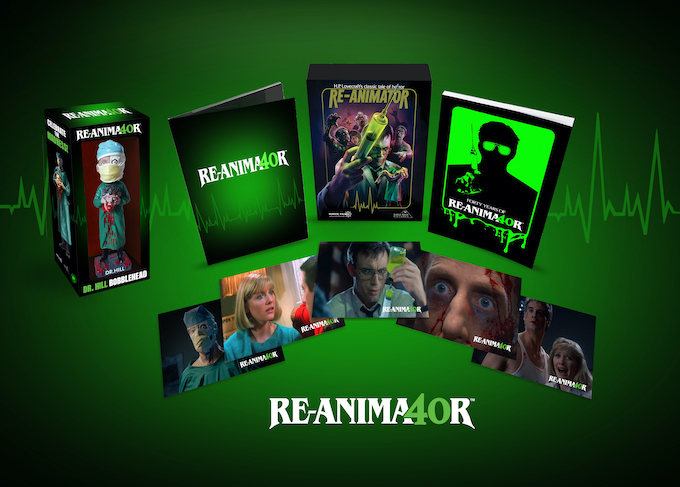
On the other hand, collector’s will surely get a kick out of the two box set versions (which I did not get): the Deluxe Edition Box Set ($80) and the Ultimate Limited Edition Box Set ($130). This is the first time Ignite has had this type of Shout-style release package. These come with goodies as follows inside a new, bigger box:
Deluxe Edition:
-Hardcover book featuring new interviews with Jeffrey Combs, Barbara Crampton, writer Dennis Paoli, and composer Richard Band. Essays by Scout Tafoya, Kate Rife, Will Sloan, Alex Kittle, and Ben Sachs. Preface by Brian Yuzna.
-Collector’s art cards
-J card
Ultimate Edition:
-Everything in Deluxe Edition
-Limited-edition bobblehead of Dr. Hill
Another pretty cool twist on the Ultimate Edition is the possibility of getting some bonus items, including a green “re-agent” vial, a signed poster by Jeffrey Combs, Barbara Crampton, Bruce Abbott, and Brian Yuzna, and a Re-Animator “gift pack” from Middle of Beyond. While the $50 jump from Deluxe to Ultimate is egregious if you’re just getting a bobblehead, the chance of these additional prizes might be worth the gamble for some.
Special Features
Fans of Re-Animator were not necessarily starving for content, especially with Arrow’s previously definitive release from 2017. And much of what preexisted Ignite’s 2025 version was already pretty great — especially “Re-Animator: Resurrectus,” which is on Disc 2 here. Nevertheless, I focused on the new content from Ignite — nearly 3 hours’ worth — specifically made for this release. There are seven brand-new features, plus a 40th-anniversary trailer for this 4K release. Most of them are worth the watch for hardcore fans but as a collective don’t necessarily give you much that you didn’t already have from before.
B-

“Re-Animator at 40” (45min): Producer Brian Yuzna sits down with Barbara Crampton and Jeffrey Combs for this retrospective chat in 2025, discussing locations, production schedule, and relaying some fun stories from the past, even if it strays into the granular from time to time. You might need some previous information to not only appreciate this 45-minute featurette but also to follow along with the who’s who of production. If you’re new to the movie’s behind-the-scenes content, perhaps you should start with Re-Animator: Resurrectus instead.
Aiming to deliver for us a fly-on-the-wall experience, the conversation is free-flowing but often awkward at times. If anything, this quasi-panel discussion needs some sort of moderator. Highlights include the trio’s misty-eyed reflection on the late David Gale — a great tribute for arguably the best performer in the film.
“Piece-by-Piece: Cutting Re-Animator with Editor Lee Percy” (15min): The look and feel of Re-Animator owes a lot to the vision of filmmaker Stuart Gordon. But this was only Gordon’s first feature film; his history was in the theater — more specifically the Organic Theater in Chicago, known for prop-less, experimental performances focusing more on collaborative ideas and performances. it was a resourcefulness that served him well on the 1985 film.
“Acting is the best special effect,” he once said to seasoned editor Lee Percy. Even before he got the call to work on Re-Animator, Percy was a fan of the Organic Theater. In this brief conversation, the editor details his experience on the movie and relays some fun stories from the editing room (he particularly tried to cut the “garbage to garbage” line, but to no avail). He couldn’t say enough about Gordon, relishing in the director’s infectious enthusiasm, and even recalling the meeting with the MPAA representative (“Stuart, what were you thinking??!” she said before assigning the movie an X rating). Rarely do we get to chat with film editors, so kudos to Ignite for shining the spotlight on Percy here.
“The Horror of It All: The Legacy and Impact of Re-Animator” (18min): This featurette is essentially a documentary about fans of Re-Animator, but if those fans were industry filmmakers — some of whom knew director Stuart Gordon personally. Including Joe Lynch (Suitable Flesh), Mick Garris (Masters of Horror), Mike Mendez (Big Ass Spider), and Nicholas McCarthy (The Pact), among others, the mini-doc provides some interesting insight for both longtime fans and newcomers. The Boogeyman’s Rob Savage noted that Re-Animator was one of the few ‘80s horror movies that actually lived up to the VHS cover. The directors even go from character to character, analyzing their importance to the film (“Until Hannibal Lecter showed up, Herbert West made intelligence scary”). Some guests even waxed poetic on the the importance of horror mags back then, appointing Re-Animator as the ultimate film to nerd out to, especially if you like to peek behind the curtain of makeup and effects. Compared to the other special features, this one also goes deeper into Lovecraft lore.

“Suzie Sorority & The Good College Boy: An Interview with Carolyn Purdy-Gordon” (14min): In this sit-down interview, Stuart Gordon’s wife Carolyn Purdy-Gordon recounts the story of how the couple met. They were students at the University of Wisconsin at Madison and began their relationship after he drunkenly called her one night, not knowing who she was. The chance encounter resulted in the two of them becoming phone pals for several weeks before meeting in person. The conversation leads into the impetus for the Organic Theater Company, started after Stuart and Carolyn were arrested for putting on a school play that featured nudity.
The Organic Theater Company gets a lot of coverage in these bonus features, but here you get to hear about it from the horse’s mouth. Carolyn discusses working with an unheard of David Mamet to her husband getting started in Hollywood. She appears in Re-Animator as a doctor — a role that said was natural for her because of her history as a medical aid when she was younger. The interview is brief but it’s a nice sort of closure on Gordon, who’s no longer with us. His willingness for pushing the envelope and inherent eye for structure makes him one of the most underrated horror directors, especially of that era.
“I Give Her Life: A Look Back at Re-Animator: The Musical” (28min): Not being a huge theater buff myself, I was quite enthralled with the making of the inaugural Re-Animator musical in Los Angeles, wishing I had been able to see it during its run. This conversation involves Stuart Gordon’s agent, composer Mark Nutter, and the case involved in the production (Chris McKenna, Rachel Avery, et al). In this behind-the-scenes doc, we see how many of the practical effects made their way into the stage version, translating to the medium with ease due to their nature. Like a bloody SeaWorld performance, the musical was known for spraying the front rows of the audience with fake blood. And since Gordon was obsessed with pushing everything to the limit, this got messier and messier with each passing week.
Gordon directed the production, and his ethos was imbued into every facet, from beginning each rehearsal with improv games to keeping each detail in flux, dedicated to continuously perfecting the musical throughout the weeks. Gordon was heavily involved in the nitty gritty jobs on set as well. He was an absolute workhorse, running lighting boards, helping take down sets, and being at every rehearsal and performance despite being the director — something that just doesn’t usually happen in theater.
“Re-Animating a Horror Classic: The 4K Restoration of Re-Animator” (2min): This is a very short feature (with subtitles) showing the software developed specifically for film restoration. While highly niche and a bit too brief, this is still a cool behind-the-scenes look that’s not often features in other releases. I found it interesting that for the process, each frame gets its own individual file.
“The Organic Theater Company of Chicago (1977)” (28min): Filmed by Richard Christian Jr and Ira Moshman, this is a literal documentary from 1977, spotlighting Stuart Gordon’s Organice Theater Company in Chicago. If you’ve made it this deep into the featurettes, you’ve undoubtedly heard a lot about this theater house, but now you get to see it in action during its heyday. Established in 1969, the company specialized in productions that were often born in-house, and that evolved throughout their run. This doc shows us some of their most popular plays like “Bleacher Bums,” inspired by troupe member Joe Montegna’s real-life experience at Cubs games, and the enigmatic “The Wonderful Ice Cream Suit” (still not sure what this was about).
I was intrigued by the quote from Micahel Saad, where he laments, “Being in a performance art is unlike being a painter because, at any specific point in time, you’re required to be a genius.”
Legacy Bonus Features
- Audio Commentary with director Stuart Gordon
- Audio Commentary with producer Brian Yuzna and actors Jeffrey Combs, Barbara Crampton, Bruce Abbott, and Robert Sampson
- Audio Commentary with Stuart Gordon and Re-Animator The Musical’s Jesse Merlin & Graham Skipper
- Re-Animator: Resurrectus (69min)
- A Conversation with Director Stuart Gordon and Producer Brian Yuzna (49min)
- Interview with Dennis Paoloi (11min)
- Interview with Richard Band (15min)
- Interview with Fangoria Editor Tony Timpone (5min)
- Music Discussion with Composer Richard Band (17min)
- The Catastrophe of Success: Stuart Gordon and the Organic Theater (13min)
- Theater of Blood (12min)
- Barbara Crampton in Conversation (36min)
- A Guide to Lovecraftian Cinema (54min)
- Doug Bradley’s Spinechillers 1-6 (99min)
- Extended Scenes (23min)
- Deleted Scene (3min)
- Theatrical Trailer
- TV Spots
- Still Gallery


 The Twizard
Leave a comment