
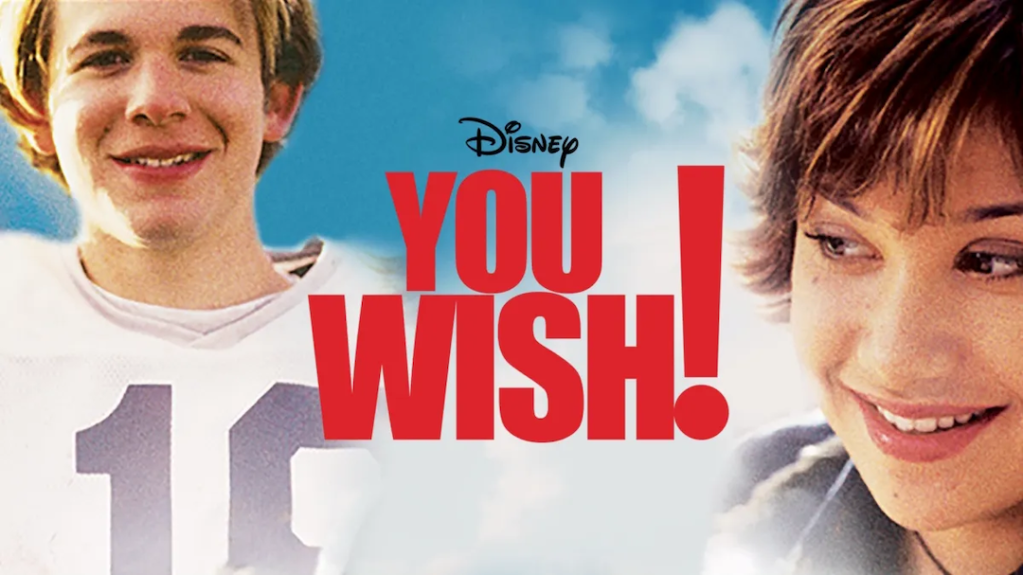

You Wish was not your ordinary DCOM. By 2003, the Disney Channel’s brand was becoming, and did become, all about aspirational entertainment. Their shows and movies revolved around kids who were famous, athletic, rich, talented, or some combination of those. But You Wish was like the counterpoint.
Starring Even Stevens’ A.J. Trauth in his first lead, the movie follows Alex, a talentless, unpopular kid from a financially-insecure family. He and his younger brother Stevie (Spencer Breslin) have a complicated relationship. While they enjoy spending time with one another every so often, Stevie’s youth and immaturity creates a sort of inevitable tension between the two boys. Only 10 years old, Stevie looks up to his 16-year-old brother, but to a fault. He wants to hang out with Alex’s friends, rifle through his coin collection, and wear his roller blades. Alex feels like he should be able to do at least some things without his brother. And his parents (aka the real villains here) don’t help, constantly playing favorites, sticking up for Stevie whenever possible.
Alex has his bullies at school but they’re never really the antagonists here. If anything, Alex and Stevie’s cultivated dynamic is to blame for their troubles. Until one day, Alex wishes on an ancient coin that he didn’t have a brother — and poof, he wakes up and Stevie’s gone.

What makes You Wish so intriguing is how it doesn’t eliminate Stevie from the equation; it merely places both brothers in an alternate reality where Alex is now a popular jock and Stevie is a famous kid actor. Both are successful but neither is happy.
The demands of the DCOM’s made-for-TV time slot urge this film to progress things quickly, and so the plot is constantly evolving. There are a lot of moving parts, and all the little story details set up in the first act come back around in significant ways.
Unlike other alternate-reality “It’s a Wonderful Life” knockoffs, You Wish keeps its stakes relatively low. Nobody dies because of the wish, nor is anything terribly different from before. Reality simply gets reorganized. And without any of the desperation that would come with something drastic, Alex is just able to focus on getting his brother back simply because he realizes life is just better that way.
Director Paul Hoen, who worked on a handful of Even Stevens episodes with A.J. already, lets us know where his head’s at. Sprinkling the first act with sweet touches between the brothers helps to see both of them as antagonists and, yet, neither of them as antagonists. Our feelings about them are the same. They share authentically sweet moments. After a fight where Alex kicks Stevie out of his room, he catches Stevie spying on him and invites him to join him on the bed to watch a movie. There’s also a family photo on the wall where everyone is looking at the camera, except Stevie who’s lovingly looking up at his brother.
If anything, the grounds for the conflict are unstable. It’s difficult to find where Stevie has messed up enough. But also, Alex is a teenager struggling with his personal life (and his terrible parents) and looking for an outlet for his frustration. Nothing is intended to be malicious here; it’s just typical brotherly tension, albeit aggravated by bad parenting.
While Alex and Stevie are written to be normal kids, the script doesn’t quite have a grasp on normal people’s behavior when it comes to ancillary characters. For one, the parents are written as cartoons with no real purpose outside of precipitating conflict. And even real-life bullies aren’t usually as unreasonable or mean as the fellow high schoolers in You Wish. At one point, a cheerleader walks up to Alex, sitting on the bench during the football game, and not only makes fun of him for not getting playing time but tells him he should be embarrassed by his family cheering him on in the stands. There’s just no precedent for this kind of mean spiritedness. And worst of all, apparently Alex has a crush on this girl?
By 2003, Disney was slowing down its Original Movie platform, shifting from one release each month in 2000 to just about one every couple of months in 2003. This strategy allowed them to put more money and time into each production. As such, You Wish was filmed in New Zealand and ditches the Disney gloss that came stock on most DCOMs around that time. Other films from this era still looked like the pre-2003 DCOMs. Hoen used clever filmmaking effects and took the time to actually remove much of the warmth from the camera. This thing looks nearly dour at times. For all intents and purposes, it doesn’t even feel like it’s from Disney at all.
Twizard Rating: 85
Listen to us break down You Wish on our podcast The Y2K Phaze!


 The Twizard
Leave a comment