

1980’s Christmas Evil may be another victim of bad marketing during a time when there was a new slasher film every weekend and holiday-themed horror was all the rage. Following a brief period of unclassifiable horror movies, which turned out to transform and redefine the genre exactly because of that ambiguity, American audiences craved the art of categorizing, thus stifling any change that may have been occurring at the time.
Opening up on Christmas Eve 1947, the film shows a young boy, Harry, excited as he watches from behind his banister as Santa Claus comes down the chimney and puts presents underneath his tree. When he goes back to bed, his brother informs him that this was, in fact, their father. However, the boy, aiming to prove his brother wrong, goes back downstairs only to discover his mother and Santa Claus engaging in sexual activity.
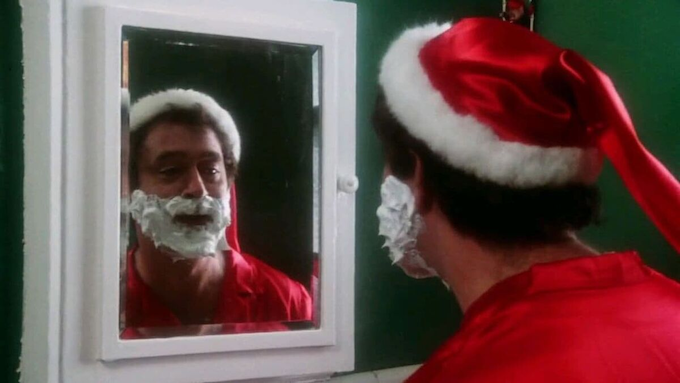
When Harry grows up (Brandon Maggart), he has an unhealthy obsession with Christmas, as well as a sick delusion that he, in fact, is Santa Claus. It starts out harmless, with him making a list of the good and bad boys and girls in the neighborhood. But eventually, he becomes violent with his punishments for the naughty adults.
The climax instantly recalls Fritz Lang’s M as the angry mob stampedes through the Europeanesque streets of this Christmas-decorated New Jersey town as they’re inexplicably equipped with period-incorrect torches. It’s an apt fanfare to cap off some of the finest Christmas production design I’ve ever seen.
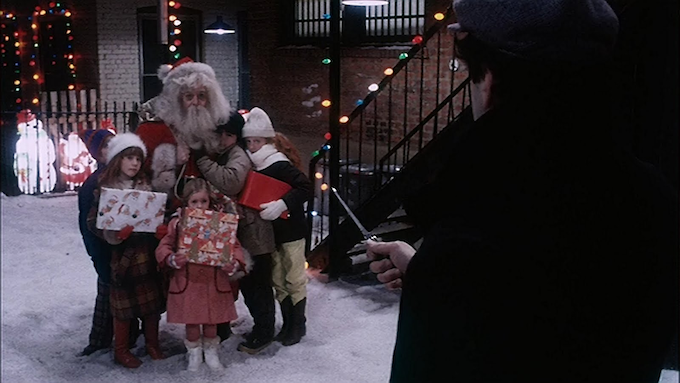
Writer-director Lewis Jackson meets the premise head-on and approaches the material with gravitas and a sense of pensiveness. The fascinating character study may have been marketed as a horror film, but modern audiences love to hold it up next to Taxi Driver, however facile that comparison may be. In Taxi Driver, Martin Scorsese attempts to blur the line between the audience and the insane, while Christmas Evil manages its dynamics much differently. Given a main character who’s less relatable than Travis Bickle, we trade empathy for sympathy and are given more evidence for his flaws. This man is seriously deranged.
We could also compare Christmas Evil to 1980’s Maniac, an ostensibly similar horror flick of the time. However, it’s easy to see that Maniac — an exploitative gore fest — is supposed to have fun with its schlock. Whereas you could hardly classify Christmas Evil as gore at all. The kills in are almost entirely understated (the first one doesn’t happen until nearly an hour in); it’s not here to have fun.
Compared to Bickle, whose perversions are that of the sexual variety, Harry becomes fixated on the preservation of innocence. There is no Madonna-Whore Complex at the center like there is in Taxi Driver, nor is there the twisted sexual appetite of Joe Spinell’s character in Maniac.
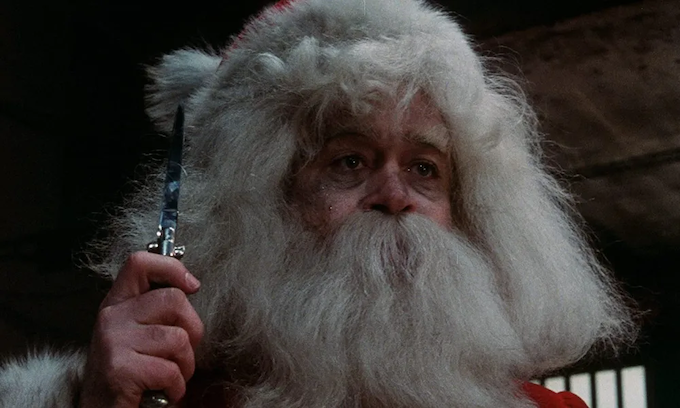
Christmas Evil speaks of Santa as the great cultural judiciary. Jackson is superb in his ability to separate the subjectivity of Harry’s perspective from the objectivity of the audience, and without letting the two compromise each other. We see why the naughty children are so bad, yet we still understand why Harry is too crazy to bring any analysis to their situation.
Don’t you dare compare this to the vastly inferior 1984 slasher Silent Night, Deadly Night. Christmas Evil is a seriously great piece of cinema; a work of art. At its essence, the film is about a real man who decides to play the role of Santa Claus, even going so far as physically attempting to go down a chimney. Ballsy in its willingness to explore perspective, Christmas Evil should not have its legacy tarnished because of bad marketing from over 40 years ago. Instead, it should be embraced as the fascinating character study it intends, and succeeds, to be.

 The Twizard
Leave a reply to The House on Sorority Row (1983) Is a Boilerplate Slasher with Splashes of Originality – The Twizard Cancel reply