
After hopelessly helming B-movies for the better part of a decade, William A. Wellman finally became a household name when he got the chance to direct Wings for Paramount in 1927. Meticulously designed to showcase the most authentic and epic display of aerial stunts at that time, and for decades that followed, Wings not only became the benchmark for aviation-themed films but also took home the first-ever Best Picture prize at the 1st-annual Academy Awards in 1929.
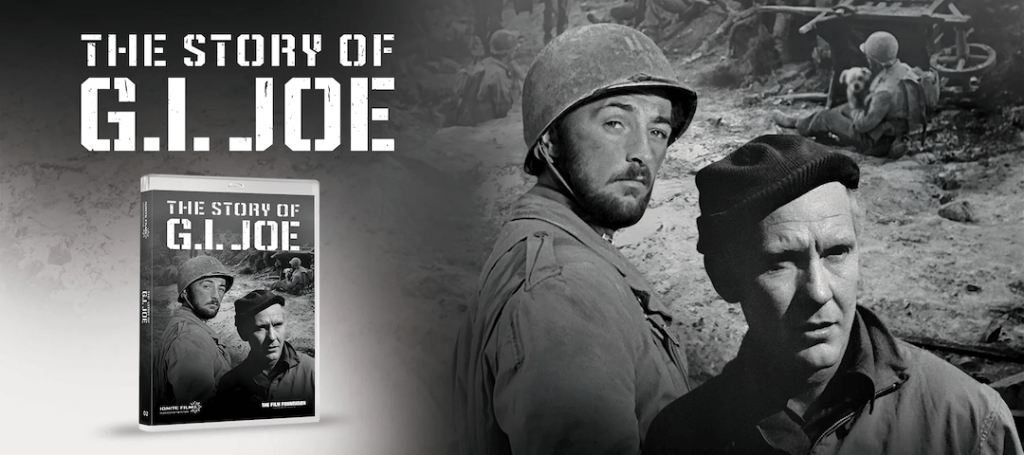
Following Wings, Wellman would direct around half-a-dozen war pictures before 1945, most of which would surround the airmen of World War I (Wellman himself served as a military pilot in the War). In 1945 alone, he would make two war movies, including his most notable to date, The Story of G.I. Joe (the other was This Man’s Navy about naval blimps), which he at one point called his best film. Now in 2024, Ignite Films is presenting the picture on Blu-Ray for the first time ever, equipped with several brand-new special features.
The Movie

If it took Wellman several pictures to feel like he properly honored military aviators soaring majestically through the sky, it took only one to pay a proper tribute to the U.S. Army soldiers battling in mud and rubble on the ground. Like reading a first-hand account of wartime experiences in a magazine, The Story of G.I. Joe is told from the perspective of Ernie Pyle, a war correspondent whose real-life columns served as the basis for the plot. Sadly, he would die in Japan from a machine gun bullet to the head, mere months before the movie’s release.
Just like cinema historically served to transport audiences to different times and places — teleportation realized, if you will — Pyle’s columns humanized the soldiers to the point that they allowed civilians at home to feel as if they were there with them overseas. War films could only do so much, but The Story of G.I. Joe was the connective tissue.

Taking a slice-of-life approach to the tale of the legendary 18th Infantry Regiment of the U.S. Army, the movie slowly develops the camaraderie between Pyle (Burgess Meredith) and the other soldiers, all led by Lt. Bill Walker (Robert Mitchum). Saying the film is low-concept would be an understatement. Instead, it plays out in episodic chapters as they push through Italy to get to Rome: arguments about music as they listen to the radio under starlight, an ad hoc wedding (featuring Wellman’s wife Dorothy), excitement during mail call, several shootouts, a mediocre Christmas dinner, and much more. There’s also a through-line regarding the hunt for a phonograph player by Sgt. Warnicki (Freddie Steele) and a powerful sequence at an old church.
In terms of the authenticity of the battlefield, Wellman picks up right where he left off with Wings, trading the plane-filled skies of World War I with the groundsmen of World War II — both facing off against the German enemy in their respective conflicts. In the 1945 film, the realism of the narrative is matched with guns recoiling, shot soldiers falling 20 feet to their death off the ruins of an old church, and rocket launchers firing and hitting these buildings all in a single take. Needless to say, this pushed the envelope of what the censors would allow but thanks to President Roosevelt overriding censorship for Louis Hayward’s 1944 documentary short With the Marines at Tarawa, Wellman was engendered to leave much of it in.
He also cast real-life veterans in some of the roles. 150 soldiers were used as extras. For any modern-day filmmaker looking to bring a level of realism to his or her war pictures, look at how infrequently Wellman cuts away from the action. Each shot is a complete moment, and we feel like we’re witnessing documentary footage much of the time. Apparently, Wellman ignored the camera angles written into the script and instead diagramed each shot on the back of the pages instead, tapping editor Albrecht Joseph to bring this vision to life. The editing in the film is superb and would inform the likes of future War pictures like Platoon and Saving Private Ryan.

Pyle is the protagonist in name only. Instead, he largely serves a utilitarian purpose as a window into these men’s lives. Meredith, with his hunched posture and balding scalp, stands out like a sore thumb amidst this group of strapping young soldiers. While they banter and make quips, he can’t help but smile at their cleverness; his wit is better appreciated on paper.
Burgess Meredith is not your typical leading man here. He’s not vying for your attention but aiding the story of the men around him. He properly reflects Pyle’s ability to observe from the shadow of heroes –– leading men in their own plays.
Meredith’s soft, unassuming nature serves as an improbable contrast to Mitchum’s unfathomably cool yet rigid demeanor. The best scene in the film is one where the two men are sitting alone on Christmas, getting drunk on grappa. Finally able to find a moment where they can afford to breathe and reflect, they unload all of their thoughts and feelings, displaying a level of perspective that would feel too ham-fisted in any other type of movie. But here, where the stakes are unparalleled, it comes late in the film at the perfect time.
The scene reveals perhaps the film’s greatest strength: its dialogue, gathered in a script credited to Leopold Atlas, Guy Endore, and Philip Stevenson, who got nominated for the Academy Award for Best Screenplay. The scene also shows just how Meredith and Mitchum are on a whole different tier with their performance abilities, with Mitchum getting a Best Supporting Actor nomination (the film was also nominated for Best Score and Best Original Song).

Other war pictures made and released while the War was still happening have profound messages or at least a clear arc for their characters. Instead, The Story of G.I. Joe is more concerned with the thoughts and actions of its men; this is no propaganda piece either for or against the War. Much like Pyle’s writings, it aims to shine a light on who each of these men are, with or without their position as soldiers. And how their bond will help carry them through with positivity, each in his own way. Only one man, Sgt. Warnicki, is shown caving to despair after he hears the recorded voice of his son and has a nervous breakdown at the end of the film.
Wellman was a master when it came to fusing realism with uniquely cinematic conventions but he was hardly an innovator in terms of narrative formula, save for how he changed the approach that future filmmakers took towards war pictures. For The Story of G.I. Joe, he obviously looks to past masterpieces such as Lewis Milestone’s All Quiet on the Western Front and Howard Hawks’ Air Force (both Milestone and Hawks were offered the director’s chair for G.I. Joe before Wellman). But this is no copycat movie. Without Wellman’s vision, you’d also lose his personal touch. He’s always known how to make boilerplate action look interesting, if not revolutionary, even nearly 80 years later. But it’s his focus on the “who” of war, not the “why,” that makes this 1945 film a touchstone for the genre.
The Blu-Ray

Picture
First, I need to give praise to the glorious cinematography of Russell Metty, whose black-and-white contrast brings a dimension and an extra level of artistry to a potentially dry subject. You can see Metty’s chiaroscuro in films like Touch of Evil and The Stranger, but he translated just fine to color photography as well, earning the Oscar for his work on Stanley Kubrick’s Spartacus.
For this film transfer by Ignite, the picture is serviceable but at times feels like it’s struggling to bring a crispness to certain frames if you look carefully enough. As beautiful as Metty’s shadows and silhouettes are, we don’t always see them to their full potential. Despite exhaustive restoration tactics, we still see flicker on some shots, especially noticeable early on. Of course, the “The Story of The Story of G.I. Joe” feature discusses the troubles behind the restoration since much of the original camera negative had rotted away and was unusable. For instance, the final shot was taken from a 3rd-generation duplicate 16mm print. All things considered, the end result is rather impressive.
B+
Sound
Old movies on DVD are hardly ever as clear sounding as newer ones, especially when loud explosions and plane buzzing are involved. War films are some of the worst exposers of sound mixing. Regardless, the audio for this transfer seems to alternate between reasonably clear and swallowed dialogue. I turned on the subtitles after about 4 minutes when I realized it would be an issue for the rest of the film — and I wasn’t wrong. Oddly enough, the kabooms of tanks and barrage of weaponry only added to the authenticity of the warfare as conversations within the bunkers got drowned out. And much of the dialogue in these early scenes, especially, is merely auxiliary and contextual at best.
D+
Packaging
I was hoping for the clear Blu-ray case like we see on the Ignite’s website. Instead, mine had the blue-colored case, which I’m typically not a fan of. Equipped with a somewhat thin slipcover (but a slipcover no less), the Blu-ray is pretty bare-bones in terms of packaging. While there is attractive new black-and-white poster art on the front of the box (as seen above, it’s a two-shot of Mitchum and Meredith), there’s no reversible artwork and no booklet inside, or even a paper slip. However, for $35, the packaging is still more than presentable when viewing it on the shelf. There’s also a DVD version available for $23 but without a slipcover.
C+
Special Features
While there aren’t a plethora of special features, the ones that are present are pretty great. After watching all of the content, I felt like I received a thorough education on the film, the people involved, and the story behind it. While the production of the features themselves paled in comparison to, say, what Criterion puts out, Ignite is a new label with only two releases thus far, and this is a fantastic start.
B+
“Audio Commentary by Alan K. Rode”: If for whatever reason you felt like the shorter special features provided a more cursory glance at The Story of G.I. Joe (they don’t), then Alan K. Rode’s commentary will surely feel like a deep dive. More than just a Wikipedia rabbit hole, the film historian’s exhaustive research yields dense information about the cast, crew, or situation as he discusses the movie scene by scene. When he’s not giving background on Freddie Steele’s boxing career or Arthur Miller’s early involvement in writing the screenplay (Miller would later use much of the unused material for his non-fiction book Situation Normal), Rode provides real-world context for nearly every battle sequence and educates us on filming locations for many of the scenes. He also discusses how Wellman got recruited to direct, as well as his filmmaking process, scrapped scenes, and even an original ending. We learn that this film may have been the first to feature a theme song over the opening title and that the original script was a whopping 190 pages, cut down to just 116.
If this Blu-Ray release were to have just one special feature, it should be Rode’s commentary, which serves as an invaluable companion to the movie itself.

“Wild Bill’s Dog Face Blues” (16min): This is a video essay by Scout Tafoya, providing a brief history of Wellman before giving his critical analysis of the film. With some nice insight, Tafoya’s voiceover narration is a bit difficult to understand at times with him whispering some of the script. Nonetheless, this feature is a nice supplement to the film itself, if not only to give historical context for its release and some background.

“New Interview with Bill Wellman Jr.” (16min): You can briefly see William Wellman’s son, William Jr., in The Story of G.I. Joe during one scene as a kid who asks a soldier for cigarettes. For this 2024 interview, Bill Jr. paints a picture of who his father was as a person, both on set and behind the scenes. Detailing Wellman’s relationships with actors (most notably Mitchum and Steele) and producers, his son pulls from his own experiences with his father. But perhaps the most elucidating detail comes from the revelation that, as a flyer in World War I, Wellman had his own issues with the Infantry prior to meeting Pyle who offered him a fresh perspective and appreciation for the soldiers on the ground.

“The Story of The Story of G.I. Joe” (7min): Giving some cursory background on The Story of G.I. Joe (much of which you can gather from the other features), film restoration supervisor Greg Kimble also provides (at the risk of this segment being misnamed) meaningful information on the transfer of the literal film and the exhaustive lengths taken to restore it to Blu-Ray quality. As a bonus, Kimble reads a segment from one of Pyle’s columns as it’s paired brilliantly with the finale of the movie.

“Trailers” (6min): This comprises of two versions of the same trailer from 1945. The first is a severely damaged version that has has some of its pieces, including the first three lines of text, gone due to nitrate decomposition. The second trailer is a restoration of the first, using improved footage. It’s always interesting to see what theatrical trailers looked like decades ago, comparing them to what we get today.
“Photo Gallery”: Here you’ll see a couple dozen press images and behind-the-scenes photographs from on set. However, the highlight is the fully printed press release from 1945, featuring in-depth information and even some clippings from some of Pyle’s own articles (although some of these are quite difficult to read on your TV).


 The Twizard
Leave a comment